
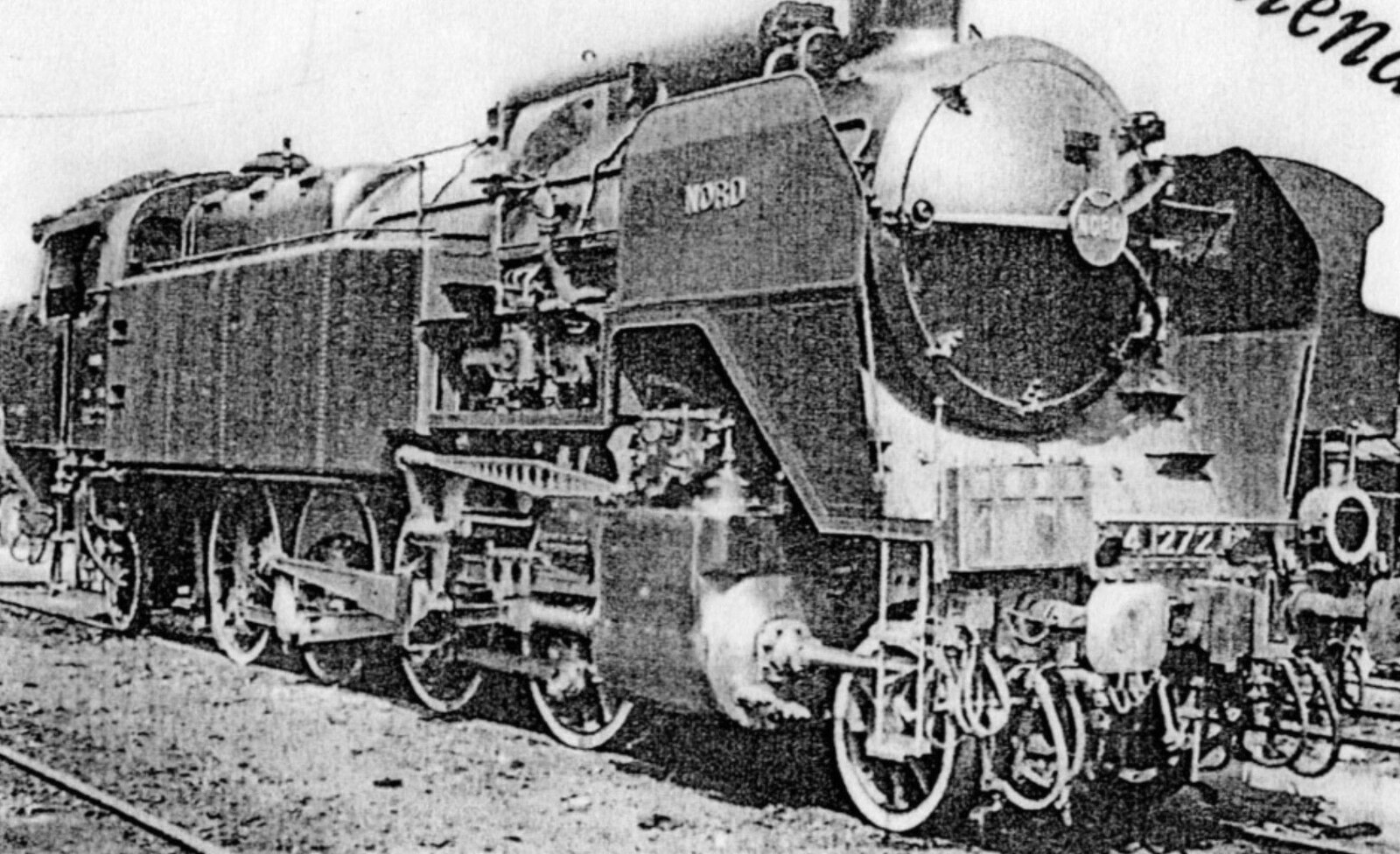
Ref. 2661 — 141 TC — NORD — No. 4.1201
Photo D.R.141 TC
France — Scale 0 (1:43.5)
For many railway enthusiasts and historians, the 141 TC is undoubtedly one of the most beautiful and successful French tank locomotives, perhaps rivaling the 5600 PO for that ranking. Sleek and powerful, it was born as series number 4-1200 of the Nord company in 1932, before becoming the 141 TC in 1938 when the SNCF was formed. Designed by the engineer Marc de Caso, it had the sad privilege of seeing the end of steam traction in France, providing, thanks to its robustness, remarkable service for some forty years on the demanding northern suburban routes.
Read the full story ↓| Company | Type | Running number | Livery | Ref. |
|---|---|---|---|---|
| NORD | 141 | 4.1201 | chocolate brown | 2661 |
| SNCF | 141 TC | 51 | green | 2661/1 |
For many railway enthusiasts and historians, the 141 TC is undoubtedly one of the most beautiful and successful French tank locomotives, perhaps rivaling the 5600 PO for that ranking. Sleek and powerful, it was born as series number 4-1200 of the Nord company in 1932, before becoming the 141 TC in 1938 when the SNCF was formed. Designed by the engineer Marc de Caso, it had the sad privilege of seeing the end of steam traction in France, providing, thanks to its robustness, remarkable service for some forty years on the demanding northern suburban routes.
These locomotives had high superheat and a single-expansion engine; total independence of admission and exhaust was essential, and this was achieved by the Cossart valve gear with piston valves and rotating cams. They were also fitted with Aubert reversibility and the Willison automatic coupler, which equipped the new suburban sets. Why reversibility? To save time at the end of the run: with a locomotive that has to be uncoupled from one end of the train and placed at the other on every return trip, the time lost shunting is considerable. With reversibility, the locomotive always stays coupled to the same end of the train (generally the provincial end, so as not to smoke out the Paris stations while standing) and, for the return, only the driver leaves the locomotive and takes his place in a small driving cab at the rear of the train, leaving the fireman on board the locomotive, which he watches over.