
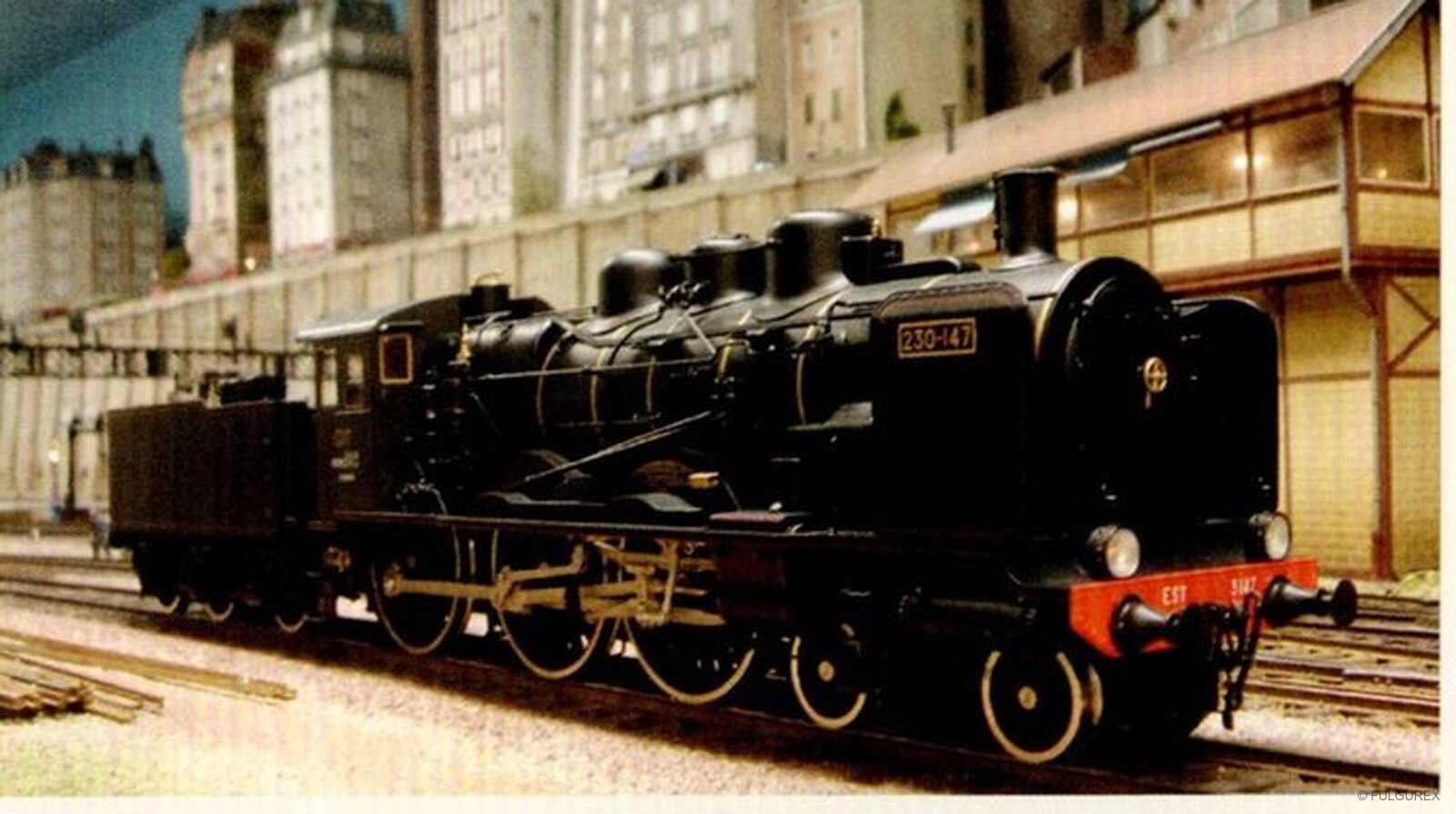
Ref. 2666 — 230 K — EST — No. 230-147
230 K
France — Scale 0 (1:43.5)
Put into service in 1903 on the Est network, the first two 230s, the prototypes 3101 and 3102, fitted with large-diameter wheels, were the origin of the famous 11 and 11 S series. The heaviest 230s built in France, intended for heavy and fast trains, were the stars of the Est network, which preferred them to Pacifics. They were designed by the Est company (engineer Salomon) to replace express engines with two driving axles, and built in two main series: nos. 3101 to 3230, delivered from 1906 to 1913 with a three-axle 22 m³ tender, and nos. 3231 to 3280, delivered from 1925 to 1927 with an interchangeable-bogie tender of 32 or 35 m³ and a Mestre platform. They gave complete satisfaction by improving timetables (an hour less on the Paris – Belfort line).
Read the full story ↓| Company | Type | Running number | Livery | Ref. |
|---|---|---|---|---|
| EST | 230 | 230-147 | black | 2666 |
| SNCF | 230 K | 159 | black | 2666/1 |
| SNCF | 230 K | 278 | green | 2666/2 |
Put into service in 1903 on the Est network, the first two 230s, the prototypes 3101 and 3102, fitted with large-diameter wheels, were the origin of the famous 11 and 11 S series. The heaviest 230s built in France, intended for heavy and fast trains, were the stars of the Est network, which preferred them to Pacifics. They were designed by the Est company (engineer Salomon) to replace express engines with two driving axles, and built in two main series: nos. 3101 to 3230, delivered from 1906 to 1913 with a three-axle 22 m³ tender, and nos. 3231 to 3280, delivered from 1925 to 1927 with an interchangeable-bogie tender of 32 or 35 m³ and a Mestre platform. They gave complete satisfaction by improving timetables (an hour less on the Paris – Belfort line).
The first 230s were built by the Est railway's workshops at Épernay, after which production was shared among several builders: Maffei in Munich, the Société alsacienne and the Compagnie générale de constructions Batignolles-Châtillon. From 1932 the Est rebuilt these locomotives drawing on the work of the engineer Chapelon (modern superheaters, boiler pressure raised to 18 bar, improved steam circuit, feed-water heaters, a second compressor, etc.): power rose by 35 % with lower water and coal consumption. The machines were numbered 230-103 to 230-280, then 230 K with the SNCF. They hauled light express trains on all the main Est lines and ended their careers on stopping trains; the last, 230 K 238, was withdrawn in 1965. Twelve of them were converted to oil firing and given a streamlined casing.