
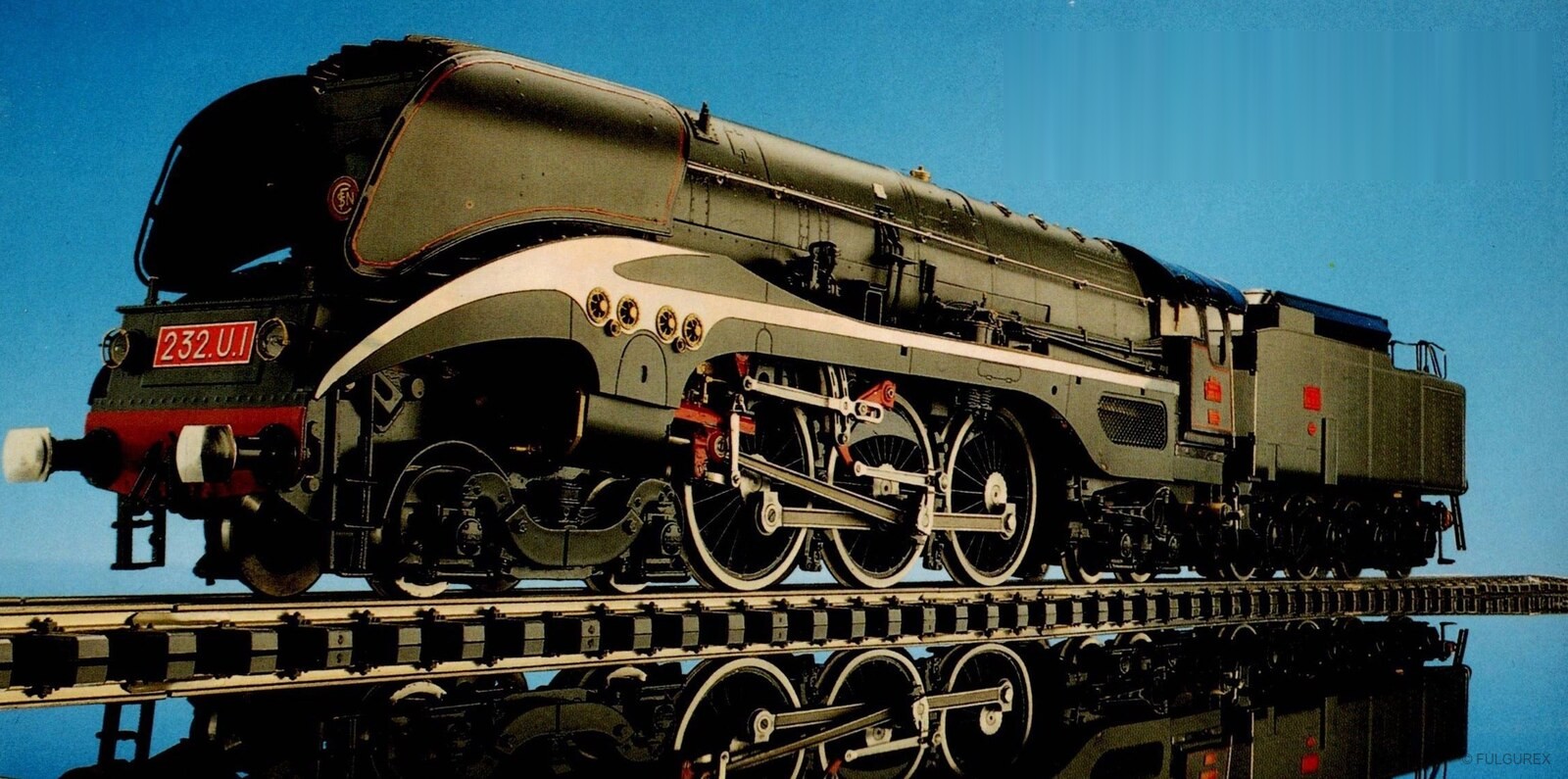
Ref. 1214/1 — 232 U "La Divine" — SNCF — No. 1
232 U "La Divine"
France — Scale 1 (1:32)
This aerodynamically elegant locomotive, designed by Marc de Caso and built by Corpet-Louvet in 1949, is the outcome of a new assessment, at the end of the war, of the power of the 232 locomotives originally developed by the Nord company as an improvement on its Pacifics. The company planned eight streamlined locomotives for light express trains: four compounds (class 232 C), three single-expansion engines (232 R) and a turbine locomotive. The first seven were built in 1939–1940 but, despite their intended purpose, were used during the war only on slow passenger services. The turbine locomotive was never completed, one reason being the SNCF's preference for compound locomotives.
Read the full story ↓| Company | Running number | Livery | Ref. |
|---|---|---|---|
| SNCF | 1 | green & black | 1214/1 |
| SNCF | 1 | green & black | 1214/2 |
This aerodynamically elegant locomotive, designed by Marc de Caso and built by Corpet-Louvet in 1949, is the outcome of a new assessment, at the end of the war, of the power of the 232 locomotives originally developed by the Nord company as an improvement on its Pacifics. The company planned eight streamlined locomotives for light express trains: four compounds (class 232 C), three single-expansion engines (232 R) and a turbine locomotive. The first seven were built in 1939–1940 but, despite their intended purpose, were used during the war only on slow passenger services. The turbine locomotive was never completed, one reason being the SNCF's preference for compound locomotives.
After the war it was rebuilt as an improved Hudson-type compound, keeping the turbine locomotive's bar frame: this was the 232 U 1. The improvements concerned the cylindrical pistons with four valves driven by external Walschaerts valve gear, ball-bearing axles, lubrication, simplified regulation and a mechanical stoker. Despite the success of the conversion, no further example of the type was built, as the SNCF was turning its attention to electrifying its network. This unique locomotive worked mainly between Paris and Lille. Today it is preserved in excellent condition at the Mulhouse museum.