
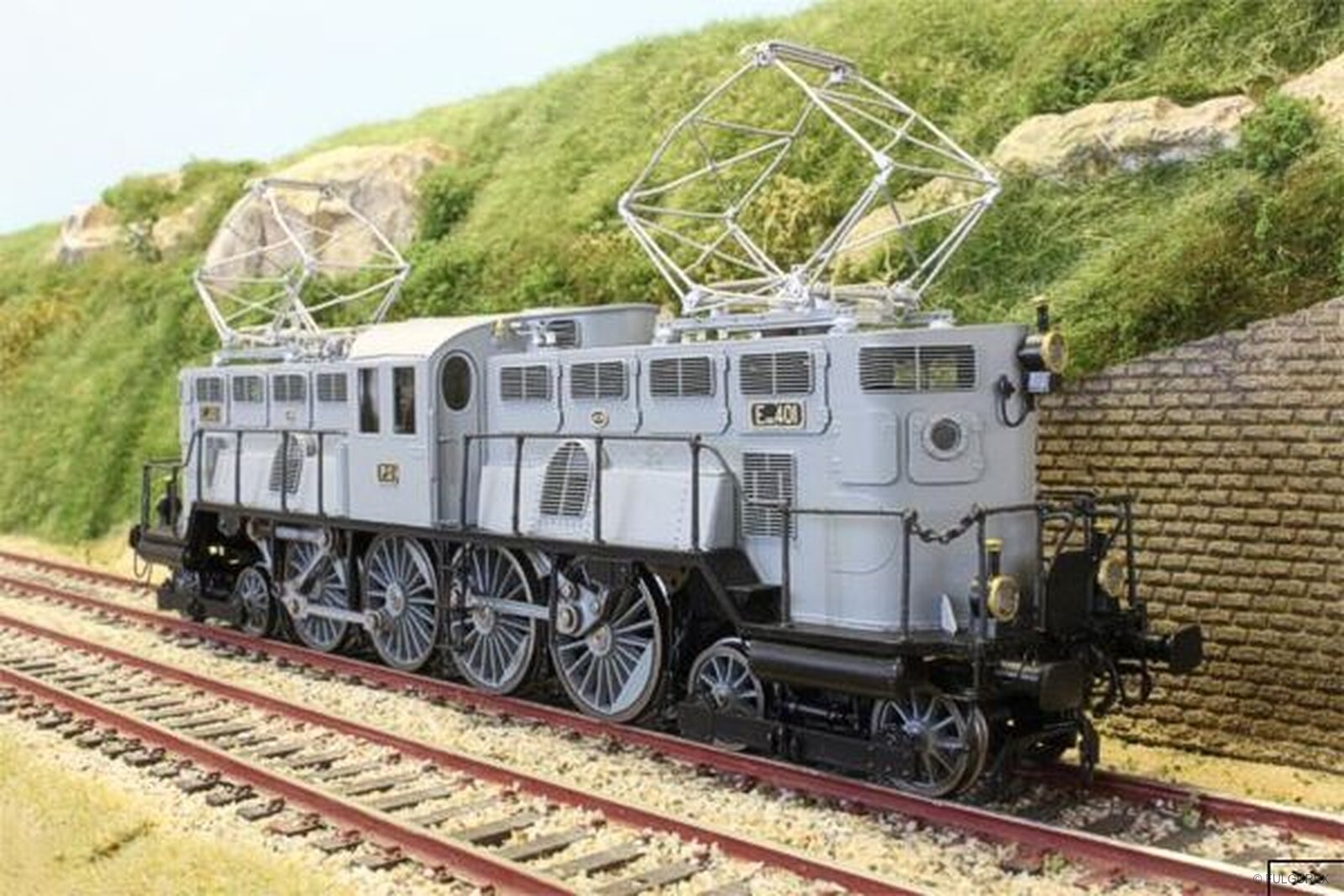
Ref. 2227 — E 401 and E 402 "La Hongroise" — PO — No. E 401
E 401 and E 402 "La Hongroise"
France — Scale H0 (1:87)
The P.O.'s choice of the Hungarian firm Ganz to design these two prototypes may seem surprising at first sight. The company had never supplied any equipment to France and was known only for the three-phase locomotives it built for the Lecco – Sondrio (Valtellina) line in Italy. But Parodi, the engineer in charge of the P.O.'s electrification, and Kandó, head of Ganz, had built up professional and friendly ties over the years. In any case, the two machines, bought for 3,200,000 francs, were delivered in September 1926 without pantographs, motors or connecting rods to ease their transport. They were finally assembled in the company's workshops at Vitry.
Read the full story ↓| Company | Type | Running number | Livery | Ref. |
|---|---|---|---|---|
| PO | E 401 and E 402 | E 401 | gray | 2227 |
| PO | E 401 and E 402 | E 402 | green | 2227/1 |
The P.O.'s choice of the Hungarian firm Ganz to design these two prototypes may seem surprising at first sight. The company had never supplied any equipment to France and was known only for the three-phase locomotives it built for the Lecco – Sondrio (Valtellina) line in Italy. But Parodi, the engineer in charge of the P.O.'s electrification, and Kandó, head of Ganz, had built up professional and friendly ties over the years. In any case, the two machines, bought for 3,200,000 francs, were delivered in September 1926 without pantographs, motors or connecting rods to ease their transport. They were finally assembled in the company's workshops at Vitry.
From 1926 to 1929 the two machines brilliantly hauled the Sud-Express from Paris to Vierzon at speeds close to 110 km/h. In service until 1938, the E 401 was scrapped in 1942 and the E 402 in 1945. The E 401 had a Kandó transmission with hyperstatic connecting rods and a rigid triangulation, reproducing the layout developed on the Italian three-phase machines. The E 402 was fitted with a Kandó-Parodi transmission with isostatic V-shaped connecting rods and no triangulation, allowing elastic links between the motor armature and the connecting-rod heads.