
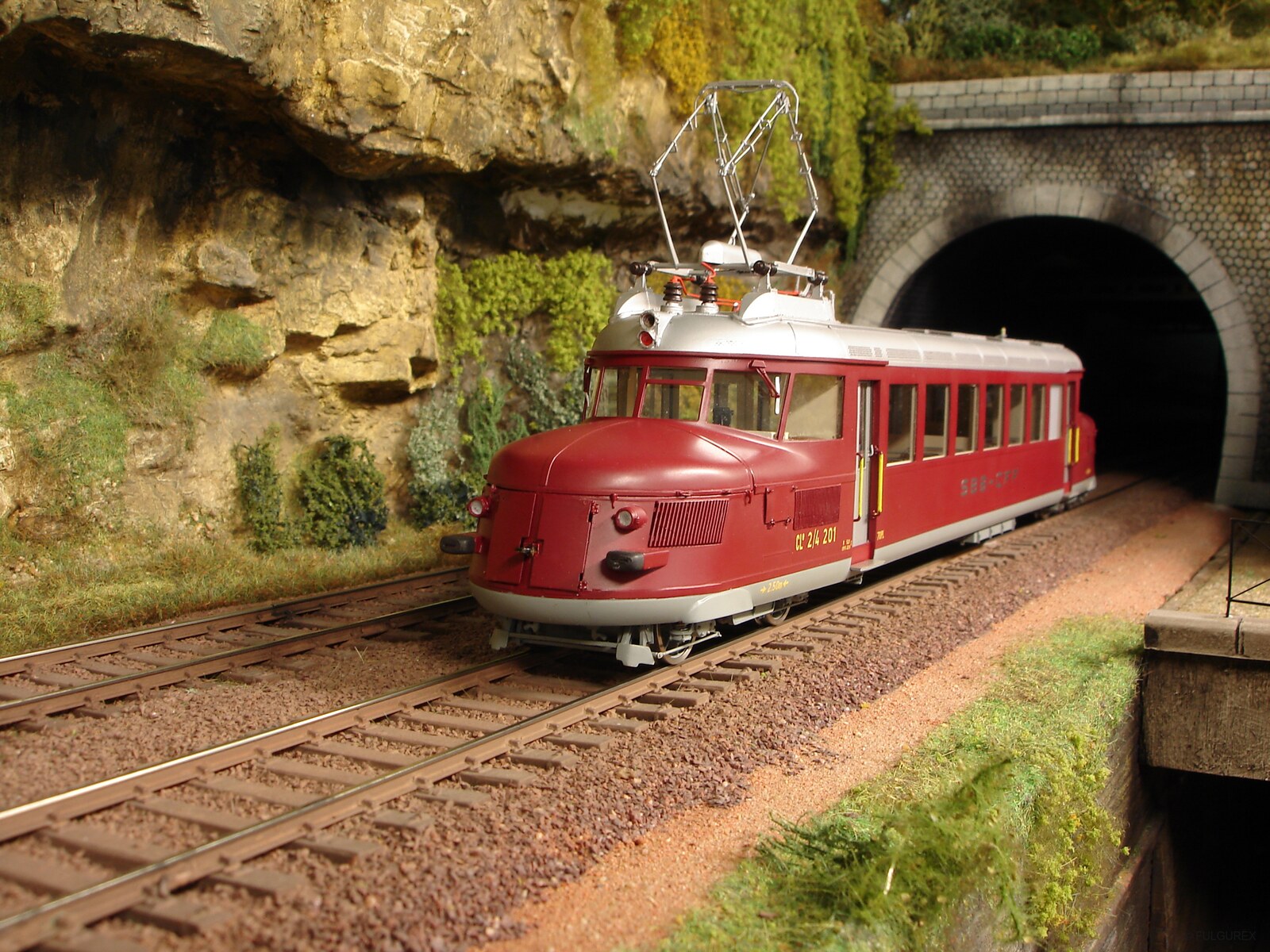
Ref. 2668 — CLe 2/4 and RAe 2/4 “Red Arrow” — SBB/CFF/FFS — No. 201
CLe 2/4 and RAe 2/4 “Red Arrow”
Switzerland — Scale 0 (1:45)
This streamlined express railcar was extremely popular in the 1930s. The first vehicle, CLe 2/4 no. 201, entered service on 24 April 1935 and is the origin of the "Red Arrows". A train of this kind was new to the Swiss network and caused a sensation. No. 201 originally had spoked wheels and a lightweight construction, and was the only one painted dark red (later light red). Its top speed of 150 km/h was remarkable for the time, as were its design innovations: lightweight materials, a single pantograph, rheostatic braking, and no couplers or buffers. The interior, bright but very simple, had automatic platform-height doors, tubular-frame seats and large windows; for the first time, passengers could look over the driver's shoulder, or even take one of the much-coveted seats beside him.
Read the full story ↓| Company | Type | Running number | Livery | Ref. |
|---|---|---|---|---|
| SBB/CFF/FFS | CLe 2/4 | 201 | red | 2668 |
| SBB/CFF/FFS | RAe 2/4 | 1001 | red | 2668/1 |
| SBB/CFF/FFS | RAe 2/4 | 1002 | red | 2668/3 |
This streamlined express railcar was extremely popular in the 1930s. The first vehicle, CLe 2/4 no. 201, entered service on 24 April 1935 and is the origin of the "Red Arrows". A train of this kind was new to the Swiss network and caused a sensation. No. 201 originally had spoked wheels and a lightweight construction, and was the only one painted dark red (later light red). Its top speed of 150 km/h was remarkable for the time, as were its design innovations: lightweight materials, a single pantograph, rheostatic braking, and no couplers or buffers. The interior, bright but very simple, had automatic platform-height doors, tubular-frame seats and large windows; for the first time, passengers could look over the driver's shoulder, or even take one of the much-coveted seats beside him.
From 1951 the seven Red Arrows in service were rebuilt: the body was lengthened by 2.8 m (recognizable by the third side cab window), the interior completely renewed and the capacity reduced to 60 seats. Since no cars could be coupled to them, they eventually became too small; after the Second World War the SBB used them mainly for group outings and special trips. Their appeal also had a downside: frequent breakdowns, mainly short circuits in the transformers and resistors, to the point where the railcar sometimes had to be pushed onto a siding to clear the line.