
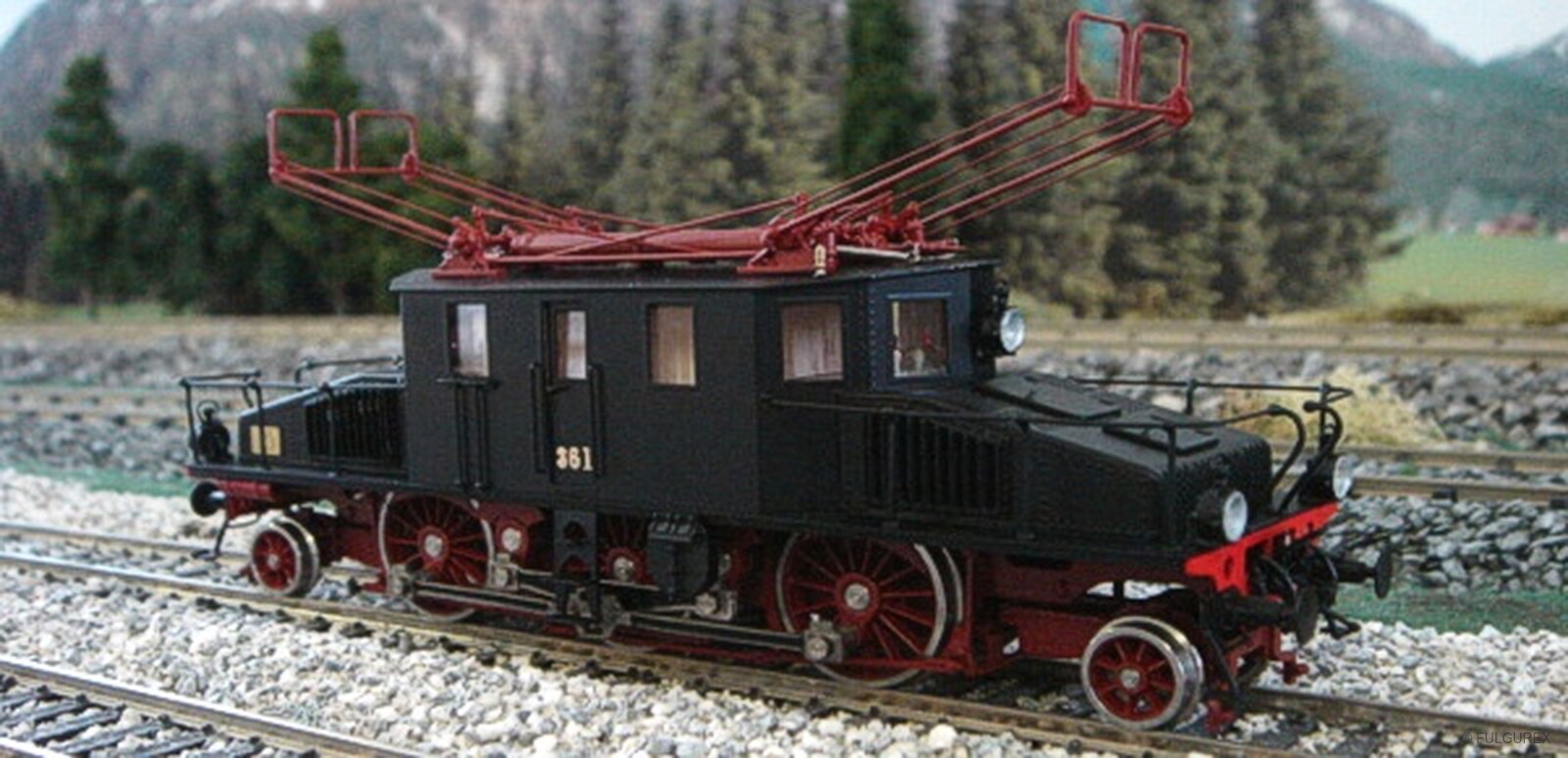
Ref. 2239 — RA and Fb 3/5 (Simplon three-phase locomotives) — FS — No. 361
RA and Fb 3/5 (Simplon three-phase locomotives)
Switzerland / Italy — Scale H0 (1:87)
Special series for the centenary of the Simplon tunnel (1906–2006). The Swiss history of these locomotives began with the Italian State Railways (FS) renting three machines to BBC for operation in the Simplon tunnel. They were so-called "three-phase" locomotives. At that time it was not yet possible to build gear transmissions for high power, so the motor speed was limited to values that could be transmitted to the driving axles without a reduction gear. All these locomotives had two very striking pantographs, mounted at the ends of the roof and always raised together because of the dead sections over points.
Read the full story ↓| Company | Type | Running number | Livery | Ref. |
|---|---|---|---|---|
| FS | RA | 361 | black with red chassis | 2239 |
| FS | RA | 362 | isabelline brown | 2239/1 |
| SBB/CFF/FFS | Fb 3/5 | 364 | green | 2239/2 |
| SBB/CFF/FFS | Fb 3/5 | 365 | green | 2239/3 |
Special series for the centenary of the Simplon tunnel (1906–2006). The Swiss history of these locomotives began with the Italian State Railways (FS) renting three machines to BBC for operation in the Simplon tunnel. They were so-called "three-phase" locomotives. At that time it was not yet possible to build gear transmissions for high power, so the motor speed was limited to values that could be transmitted to the driving axles without a reduction gear. All these locomotives had two very striking pantographs, mounted at the ends of the roof and always raised together because of the dead sections over points.
The mechanical construction of nos. 364 and 365 largely matched the two FS "rental locomotives". When looking at photographs of nos. 361–365 the paraffin lamps stand out above all. As the machines had electric interior lighting but no battery, the headlights depended on the line voltage, which was not acceptable in tunnel working; paraffin lamps were therefore prescribed for running in the tunnel in case of power cuts. The locomotives also differ in their various front sections, fans and brake-cooling units.