
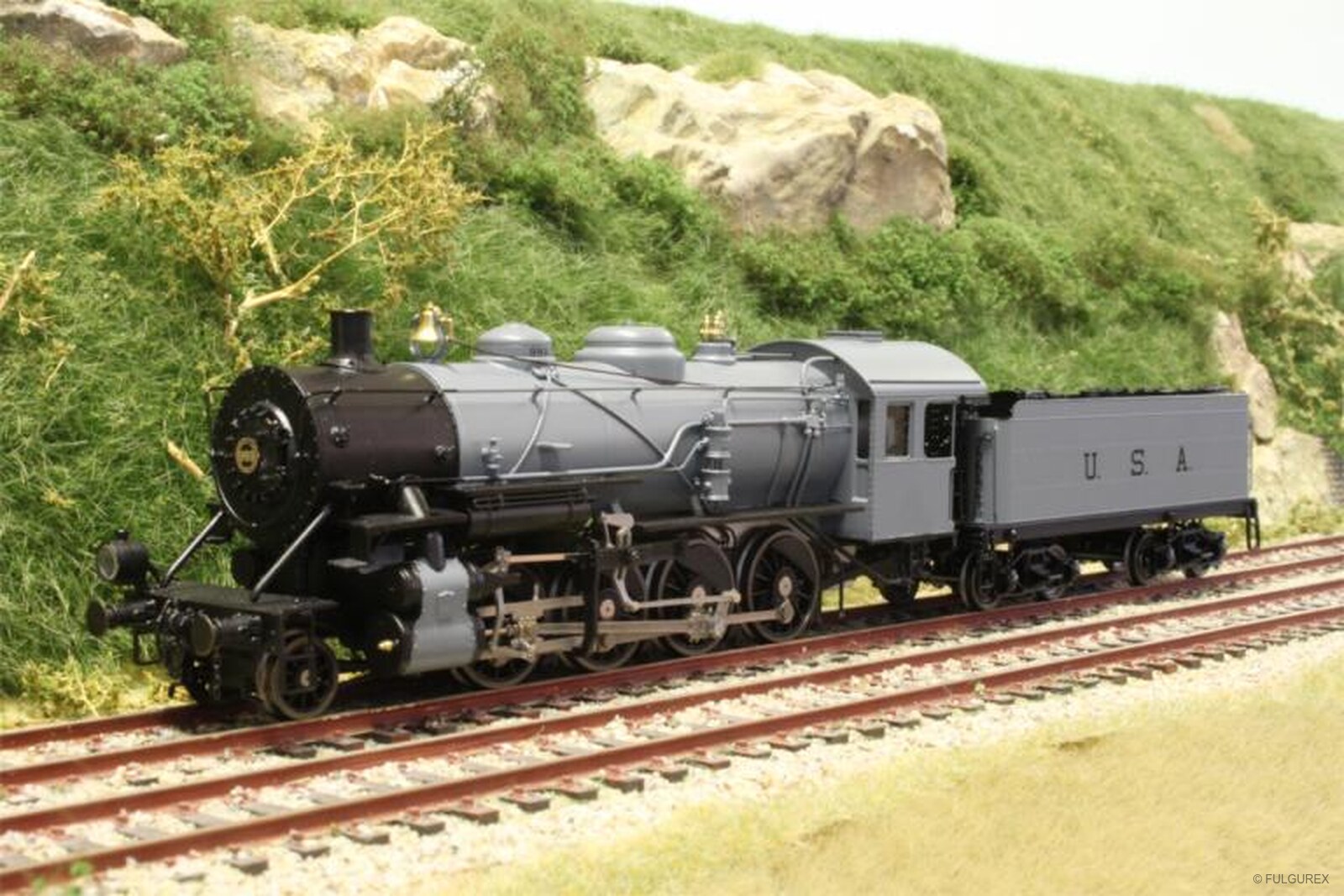
Ref. 2256 — 140 and 140 G "Pershing" — USA — No. 989
140 and 140 G "Pershing"
United States / France — Scale H0 (1:87)
The 140 G locomotives are, numerically, the largest series of locomotives ever to run on the French networks. They were ordered from Baldwin (USA) by the American army in 1917, for the needs of the US expeditionary force on the French front, and delivered from 1917 to 1920: 2,200 machines were delivered to Europe. At the end of the First World War the French Ministry of Public Works bought 1,916 of them (the others were handed over to other countries) and distributed them among all the French networks. On 1 January 1938 each region assigned SNCF numbers to the locomotives it owned; on 1 November 1947 the unified 140 G numbering was applied to the 1,408 machines still in service.
Read the full story ↓| Company | Type | Running number | Livery | Ref. |
|---|---|---|---|---|
| USA | 140 « Pershing » | 989 | gray & black | 2256 |
| AL | 140 « Pershing » | 121 | black | 2256/1 |
| PO | 140 « Pershing » | 7214 | gray | 2256/4 |
| ETAT | 140 « Pershing » | 1431 | green | 2256/5 |
| NORD | 140 « Pershing » | 4.1435 | black | 2256/6 |
| SNCF | 140 G « Pershing » | 692 | green | 2256/7 |
| SNCF | 140 G « Pershing » | 57 | green | 2256/8 |
| EST | 140 « Pershing » | 40.137 | black | 2256/2 |
| PLM | 140 G « Pershing » | 140 G 3 | green | 2256/3 |
The 140 G locomotives are, numerically, the largest series of locomotives ever to run on the French networks. They were ordered from Baldwin (USA) by the American army in 1917, for the needs of the US expeditionary force on the French front, and delivered from 1917 to 1920: 2,200 machines were delivered to Europe. At the end of the First World War the French Ministry of Public Works bought 1,916 of them (the others were handed over to other countries) and distributed them among all the French networks. On 1 January 1938 each region assigned SNCF numbers to the locomotives it owned; on 1 November 1947 the unified 140 G numbering was applied to the 1,408 machines still in service.
Designed for wartime service and slow running, above 50 km/h they suffered, because of their exaggerated rear overhang and the faulty suspension of the last two axles, from an intolerable yawing motion that made the fireman's work particularly hard. They were nevertheless robust, economical machines to maintain, used as "maids of all work". All the 140 Gs were written off by 1955; the American machines of 1945, the 141 Rs, quickly displaced their elders of 1919.