
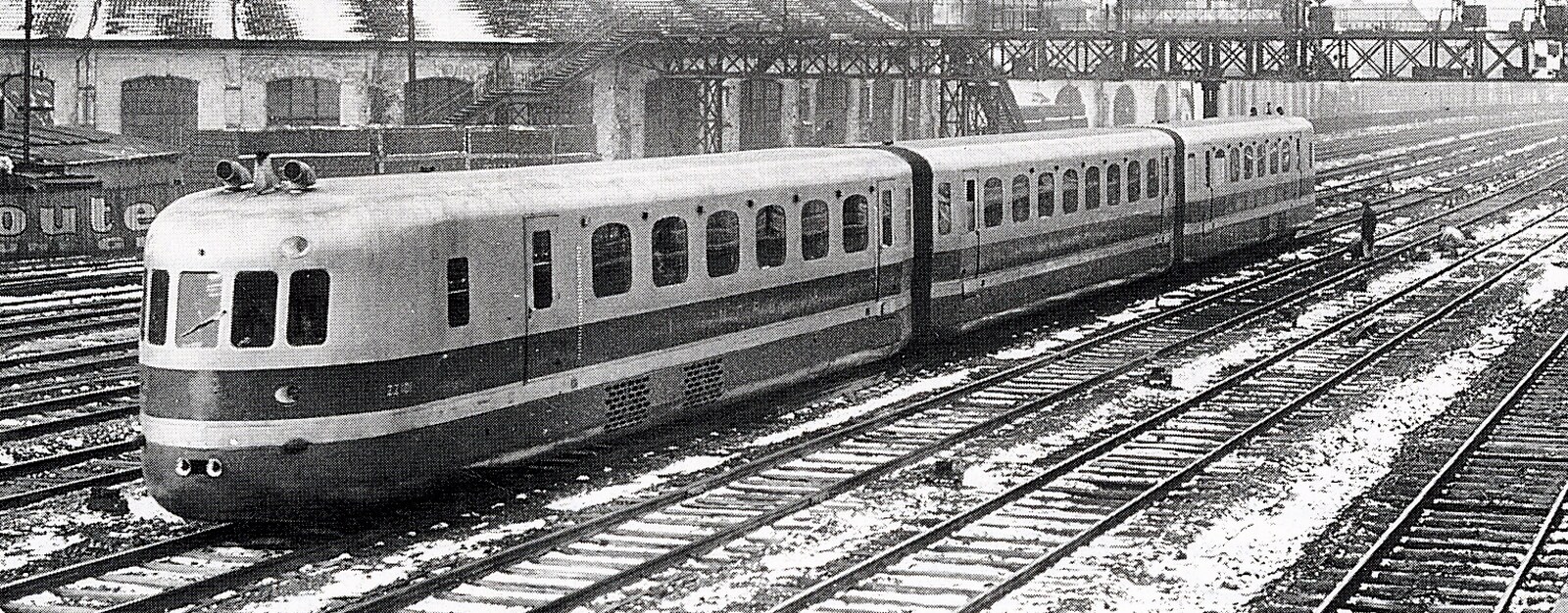
Ref. 2244 — TAR 34 and TAR 36 — NORD — No. ZZ 104
Photo D.R.TAR 34 and TAR 36
France — Scale H0 (1:87)
Two TAR (Train Automoteur Rapide) railcar sets were put into service on 27 July 1934 by the Compagnie des chemins de fer du Nord, then a pioneer of speed on the French network. These highly streamlined three-car units, fitted with two powerful 12-cylinder Maybach engines, were able to run at 140 km/h by special dispensation, since in 1934 train speeds were still limited to 120 km/h by a decree of 1853. The TAR railcars worked Paris – Lille in 2 h 25 on weekdays; on Sundays they served the then very popular Lille – Boulogne-sur-Mer line. At the end of 1935 an order for eight further units brought the fleet to 10; in 1936 the cars were modernized (bar, livery, more modern Maybach engines, etc.).
Read the full story ↓| Company | Type | Running number | Livery | Ref. |
|---|---|---|---|---|
| NORD | TAR 34 | ZZ 104 | green & gray | 2244 |
| SNCF | TAR 34 | XF 1002 | green & gray | 2244/2 |
| NORD | TAR 36 | ZZ 112 | green & gray | 2244/1 |
| SNCF | TAR 36 | XF 1105 | green & gray | 2244/3 |
| SNCF | TAR 36 | XF 1107 | green & gray | 2244/4 |
Two TAR (Train Automoteur Rapide) railcar sets were put into service on 27 July 1934 by the Compagnie des chemins de fer du Nord, then a pioneer of speed on the French network. These highly streamlined three-car units, fitted with two powerful 12-cylinder Maybach engines, were able to run at 140 km/h by special dispensation, since in 1934 train speeds were still limited to 120 km/h by a decree of 1853. The TAR railcars worked Paris – Lille in 2 h 25 on weekdays; on Sundays they served the then very popular Lille – Boulogne-sur-Mer line. At the end of 1935 an order for eight further units brought the fleet to 10; in 1936 the cars were modernized (bar, livery, more modern Maybach engines, etc.).
From 1947 to 1950 some TAR sets were used on Paris – Basel and Paris – Lyon services, setting a European speed record on the latter in 1950 over more than 500 km non-stop. The last examples were withdrawn on 30 May 1959.